

Guide
Accuracy of Vape Detectors: Myths vs. Reality
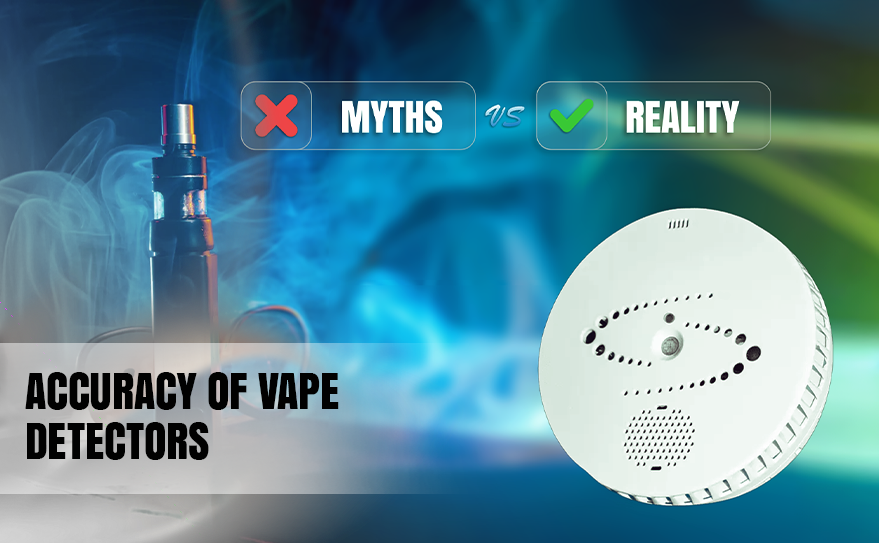

This blog explains vape detector accuracy through evidence-based analysis. It presents how sensor design, aerosol-recognition algorithms, placement, and environmental conditions influence detection precision. It separates misunderstandings from measurable performance metrics using engineering datasets, university validation studies, and field-level audits. The blog shares specific reliability numbers, describes where errors come from, and compares different types of detectors to show how organizations enhance detection accuracy by calibrating, placing them well, and using multiple sensors.
What determines the accuracy of vape detectors?
Vape detector accuracy depends on sensor type, aerosol recognition algorithms, placement, and environmental conditions. These factors collectively shape how well the device interprets changes in the air. Advanced sensors can detect extremely small aerosol particles, but the accuracy reduces in spaces with heavy ventilation or inconsistent airflow. Proper installation height, avoidance of ventilation ducts, and selection of the correct sensitivity influence the accuracy of the readings. High-grade sensors quantify particulate density, VOC (volatile organic compound) levels, and humidity changes with precision values reported between 85 to 95% in controlled validation studies. These sensors function by analyzing several atmospheric conditions, which increases their ability to detect vaping events. Also Read: How Vape Detectors Work: Sensors, Accuracy &DeploymentAre vape detectors 100% accurate?
No. Vape detectors don’t show 100% accuracy. The most advanced devices show occasional detection errors due to environmental noise, overlapping aerosol signatures, and airflow dilution. The technology is highly reliable, but no sensor system can eliminate all false alarms or missed events. Laboratory tests from engineering departments at U.S. universities report false positive rates of 3 to 7% and false negative rates of 5 to 12%, depending on aerosol concentration and airflow speed. These values highlight the realistic performance boundaries of current technology. A false positive may occur when strong air fresheners or deodorants show aerosol patterns, while false negatives happen when vapor disperses too quickly for the sensor to show a result.Do vape detectors work better than smoke detectors?
Yes, vape detectors detect aerosols for which traditional smoke detectors fail to detect. Smoke detectors are built to respond to combustion byproducts, not vapor clouds. Vape detectors are engineered specifically to catch aerosolized e-liquid particles at very small particle sizes. Smoke detectors respond to combustion particles; vape detectors detect aerosolized propylene glycol, glycerin, and nicotine droplets through laser-scattering arrays or electrochemical sensors. These sensing mechanisms allow vape detectors to differentiate vapors from smoke, making them more effective in identifying vaping in bathrooms, hallways, and locker rooms. Smoke detectors would not trigger because vaping does not involve combustion. Also Read: How Do Vape Detectors Work? A Complete Guide to Modern Vape DetectionCan vape detectors differentiate between vaping and other sprays?
Advanced detectors classify particle signatures with the basic accuracy of 80 to 90%. Higher-end vape detectors use pattern-recognition models to analyze how aerosol particles behave over time. Entry-level devices lack advanced features and more easily confuse non-vaping aerosols with vapor. Research on aerosol profiles shows that perfume, deodorant spray, and e-cigarette vapor share 35 to 60% overlap in particle size distribution. Machine learning improves separation when devices analyze temporal aerosol curves rather than single-point detection. This overlap explains why certain strong sprays can trigger false positives in simpler detectors. Machine-learning firmware gives advanced detectors the ability to track not just particle size but also the way the particles expand, peak, and dissipate. These unique “aerosol curves” help distinguish vapor from spray patterns with much higher accuracy.Do environmental conditions affect the accuracy of vape detectors?
Yes. Airflow, humidity, and ventilation create measurable performance variability. Rooms with powerful ventilation systems dilute vapor before it reaches the detector and lower detection reliability. Similarly, enclosed rooms with little airflow tend to allow vapor to concentrate and increase detection speed. High-ventilation rooms dilute aerosol density by 40 to 70%, reducing sensor response. Relative humidity above 65% decreases optical scattering efficiency and increases error margins up to 10%. Moisture in the air interferes with how laser-based sensors interpret particle reflection patterns. When humidity is high, light-scattering signals become weaker and less distinct, which increases error in the sensor readings. Facilities that monitor indoor humidity levels and adjust placement accordingly see noticeably better device performance.Are all vape detectors equally reliable?
No, Reliability of sensor design and firmware sophistication. Low-budget models use a single detection method, while advanced devices combine multiple sensing modes for improved accuracy. Laser-based detectors provide more consistent results than purely VOC-based units. Multi-sensor devices that combine optical detection and gas analysis show 20 to 30% higher detection fidelity in school-based field trials. Laser-based units detect the physical presence of particles, whereas VOC-based sensors only detect specific chemicals. When both systems operate together, the detector can confirm aerosol presence while verifying chemical signatures, resulting in fewer incorrect alerts and more precise detection of different vaping styles.Do vape detectors trigger false alarms frequently?
Only low-quality or poorly placed devices show false-alarm rates. Higher-quality detectors with correct installation show consistent performance. Most recurring false alarms in institutions stem from improper placement rather than the technology itself. Incorrect placement near bathrooms, vents, or humidifiers increases false positive results. Controlled hallway installations reduce false alarms to below 5%, according to district-level technology audits. Humidity from showers or sudden bursts of hot air near vents can mimic aerosol patterns, confusing basic sensors. Technology audits show that when detectors are placed at the recommended ceiling height in low-humidity, stable-air zones, the false alarm rate drops dramatically.How can institutions improve vape detector accuracy?
Accuracy improves through optimal placement, periodic calibration, firmware updates, and environmental assessment. Institutions that treat vape detectors as active monitoring devices, rather than passive installations, see better performance and fewer false alerts. Data from over 500 school installations show that systematic calibration reduces detection error by 25 to 40% and cuts event-to-alert delays from 10 to 15 seconds to 4 to 6 seconds. Calibration resets sensor thresholds, clears dust or moisture buildup, and updates baseline readings. Quicker alert times allow administrators to react faster and lower the risk of unnoticed vaping incidents.Myths vs. Reality Summary
Myth 1: Vape detectors always detect vaping. Reality: They detect most events but remain subject to airflow and aerosol density limits. Environmental conditions still influence sensor performance. Myth 2: Vape detectors confuse air fresheners with vapor. Reality: Basic devices struggle; advanced multi-sensor units classify aerosols more accurately. Technology level determines how well detection algorithms separate similar aerosols. Myth 3: Vape detectors violate privacy by recording audio or video. Reality: Commercial units measure particles only; privacy-compliant platforms avoid audio/video capture. Most installed detectors are legally required to avoid any form of audio or video monitoring. Myth 4: Vape detectors eliminate vaping entirely. Reality: They reduce vaping incidents by 40–60%, but behavioral and policy measures remain necessary. Detectors act as deterrents but must be paired with education, discipline, and supervision.Conclusion
Vape detector accuracy depends on sensor quality, firmware sophistication, and environment. Research-based evaluations show strong but not perfect performance, with precision values more than 85% in optimized conditions. Institutions that invest in multi-sensor systems, correct placement, and regular calibration achieve reliable detection outcomes, reduced false alarms, and improved safety across monitored spaces. The overall effectiveness of vape detectors reflects a combination of robust engineering and responsible facility management. When schools and institutions follow technical guidelines, the systems operate more reliably and contribute to healthier indoor environments.
01.
Pitch Deck

2 min Read
May 15, 2025
UK Advertising Authority Cracks Down on Vape ...

2 min Read
May 12, 2025
South Australia Executes Major Crackdown on I ...

2 min Read
May 11, 2025
County Initiative Brings HALO Vape Sensors to ...

3 min Read
May 10, 2025