

Guide
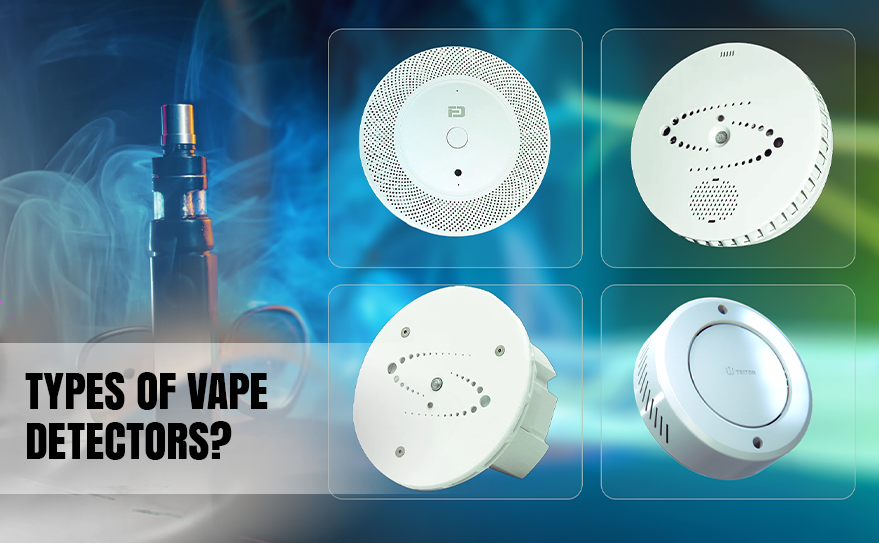
Types of Vape Detectors

Key Takeaways
- Vape detectors rely on optical scattering, air-sampling, PM sensing, and VOC chemistry.
- Hybrid systems reduce false positives and improve confidence.
- NFPA 72 matters when integrating with fire-alarm systems; ISO 21501-4 underpins PM calibration practice.
- Use detectors alongside policy, education, and ventilation—not as the only intervention.
What is a Vape Detector?
A vape detector is an indoor air monitor that flags aerosols from e-cigarettes. It looks for particle spikes, light scattering, or chemical signatures associated with vaping. Use cases: schools, workplaces, hotels, and public buildings.Why Detect Vaping Indoors?
E-cigarette aerosol contains fine particles (PM) and volatile compounds (e.g., formaldehyde, acetaldehyde, acrolein, nicotine). Indoor exposure can degrade air quality and pose health risks, especially to youth and people with respiratory disease.What are The Main Types of Vape Detectors?
1) Optical (light-scattering) vape detectors — how do they work?
They shine IR/laser light through a sampling chamber. Aerosol droplets scatter light; photodiodes measure scattering intensity. Sharp scattering spikes consistent with exhaled plumes can trigger alerts. Optical methods are standard in aerosol science and smoke detection.- Pros: Fast response (seconds), continuous monitoring, compact.
- Cons: Placement sensitive; dust or steam can confound if thresholds are loose.
- Best fit: Classrooms, restrooms, hotel corridors, offices.
2) Air-sampling (aspirati`ng) detectors — what’s different?
A small pump continuously draws air through micro-bore tubing to a central sensor. These “ASD” systems are used in early smoke detection and can identify low-level aerosols across multiple sampling points. Design and spacing follow NFPA 72 smoke detection provisions.- Pros: Very sensitive, covers large areas via tubing network.
- Cons: Higher install cost; needs pipe layout, hole equivalence, and maintenance.
- Best fit: Large facilities, atria, data rooms, airports, hospitals.
3) Particulate-matter (PM) sensor detectors — what do they measure?
These use laser photometry to estimate PM₁.₀ / PM₂․₅ / PM₁₀ mass concentration. Rapid PM spikes above baseline can indicate vaping events. Calibration good practice references ISO 21501-4 for airborne particle counters.- Pros: Numeric outputs (µg/m³), easy IAQ integration, trend logging.
- Cons: Need correction factors; can respond to non-vape aerosols (e.g., sprays).
- Best fit: IAQ dashboards, BMS-integrated buildings.
4) Chemical / VOC sensors — what do they pick up?
Electrochemical or MOS sensors look for VOCs and carbonyls characteristic of e-cig aerosols (e.g., formaldehyde, acetaldehyde, acrolein) or nicotine traces. They’re often a layer inside hybrid devices.- Pros: Adds chemical specificity beyond particles.
- Cons: Cross-sensitivities; requires periodic calibration.
- Best fit: Complaints investigation, restricted zones, labs.
5) Hybrid “multi-sensor” vape detectors — why combine?
Hybrid units fuse optical + PM + VOC (and sometimes noise, CO₂, temp/RH) to reduce false positives and improve classification. They’re typically networked (Wi-Fi/PoE) and send alerts to security or facilities teams. (General capability statements align with modern building sensors and NFPA integration practices; verify device certifications before purchase.)What Particle Sizes Do Vape Detectors Look For?
Peer-reviewed studies show e-cig aerosols contain sub-micron particles (often ~100–400 nm mass-mode; bimodal distributions with ultrafine counts). These sizes scatter light efficiently and raise PM readings quickly in small rooms.How Should Facilities Place Vape Detectors?
Place near likely vaping zones; avoid supply diffusers and high humidity sources. For air-sampling systems, NFPA 72 requires sampling-hole spacing equivalent to spot detectors for coverage equivalence. Commission with a baseline period, then set thresholds above background.How Do Vape Detectors Differ From Smoke Alarms?
Traditional smoke alarms are optimized for fire safety and may not trigger on short, localized vape plumes. Vape detectors monitor aerosol and/or chemical patterns continuously, with lower thresholds and event logging. Aspirating systems bridge both worlds when designed per NFPA 72.What About Accuracy, False Alarms, and Privacy?
- Accuracy depends on placement, baseline learning, and multi-sensor fusion.
- False alarms can occur from aerosol sprays, steam, or dust; hybrid sensing and thresholds mitigate this.
- Privacy: Many school policies prohibit audio/video capture in restrooms; most detectors sense environment only (no cameras). Public health guidance emphasizes vape-free spaces for youth.
Integration: BMS, Alerts, and Reporting
- Connect to building management systems for ventilation boosts during events.
- Use email/SMS alerts and dashboards.
- Maintain calibration logs (PM sensors referenced to ISO 21501-4 practices)
Maintenance: What’s Required?
- Quarterly dust inspection and chamber cleaning.
- Annual PM sensor calibration/verification against a reference counter (follow vendor procedures aligned with ISO 21501-4).
- Aspirating systems: confirm sampling pipe integrity and hole flow per NFPA 72 documentation.
Where are Vape Detectors Being Deployed Today?
Schools, higher-ed, corporate offices, healthcare, transit hubs, and hospitality venues report deployments; some districts publicize rollouts as part of broader youth-vaping prevention. (Note: adoption decisions vary; some toolkits caution against detectors as a sole strategy.)Buyer Checklist: How to Choose a Vape Detector
- Sensing stack: Optical + PM + VOC preferred for fewer false alarms.
- Certifications: Clarify fire-alarm interface and NFPA 72 integration if tied to life safety systems.
- Calibration: Vendor support for ISO 21501-4 aligned PM checks.
- Data & privacy: No cameras/mics in sensitive areas; follow local policy.
- Analytics: Event logs, baselines, trend charts, BMS/IT compatibility.
- Support: Clear maintenance schedule and spare parts availability.
Quick Comparison of Detector Types
01.
Pitch Deck

2 min Read
May 15, 2025
UK Advertising Authority Cracks Down on Vape ...

2 min Read
May 12, 2025
South Australia Executes Major Crackdown on I ...

2 min Read
May 11, 2025
County Initiative Brings HALO Vape Sensors to ...

3 min Read
May 10, 2025